
Boogey Wonderland: The Curse of Crystal Lake
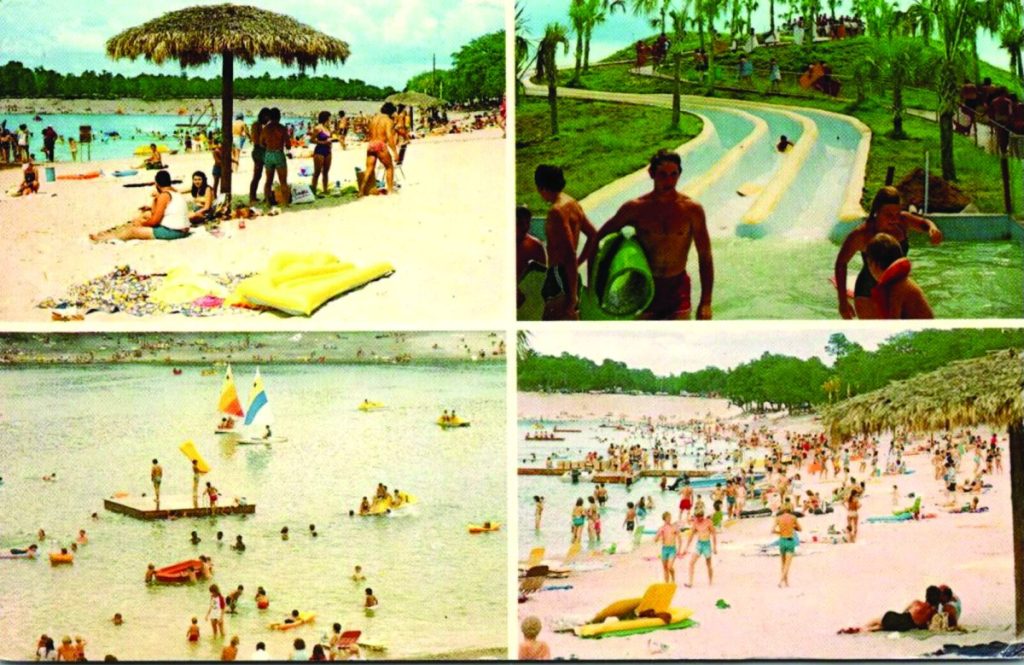
Beachgoers are shown flocking to Crystal Lake in the popular resort’s heyday: The 4th of July back in the 1980s. Photos Source: Digital Library of Georgia postcards, Ellen Payne Odom Genealogy Library, Moultrie.
Boogey Wonderland: The Curse of Crystal Lake
By Charles Shiver
“Man is in love and loves what vanishes. What more is there to say?” – W.B. Yeats
I have recently observed an upsurge in interest on social media in Crystal Lake, one of the beautiful places that I visited during the hottest months in my childhood. I hope to revisit Crystal Lake and dive deeper into the history and lore of this South Georgia landmark.
One of the treasured settings of my childhood was Crystal Lake, a privately-owned, once-popular water resort in Irwin County, 15 miles east of Ashburn. I recall the tiny fish that would nibble on your leg hairs as you waded in shorts out into the cool currents, and paddle wheel boats that you would move around the lake surface by turning pedals inside the vessels with your sunburnt feet.
Crystal Lake has been a popular recreation attraction for Turner Countians and other South Georgians since the early 1920s, according to an article by Thom. Kolesa in the Turner County Diamond Jubilee publication (1980).
This Crystal Lake was the last location you would associate with the same place name in the “Friday the 13th” horror movies featuring the machete-wielding, hockey-mask-wearing maniac Jason. Still, some folks cite the resort area’s original name of “Bone Pond” in a grisly legend dating back to the Civil War era. They speculate that this unique body of water is cursed, like Lake Lanier in north Georgia, which has been the site of several drownings and tragic accidents over the years, most recently a boat explosion that injured seven people, including a 5-year-old child, on the Fourth of July. There is also the old claim that Crystal Lake is bottomless in at least one area like the Lime Sink in the middle of Adel.
The Bone Hauntings
According to one version of the Civil War legend dating back to 1861, an old Justice of the Peace named Jack Walker was hunting for his hogs that had roamed into that area, where a runaway slave named Toney or Tony Young was hiding out. A “Yankee sympathizer” named Willie Bone (an abolitionist and a native of Massachusetts) was running a gristmill that was grinding corn for livestock on the lake. Bone had previously housed two escaped Federal prisoners at his home.
Bone tried to hide Toney, but Jack Walker found the slave and tried to take Toney into custody. Bone ended up trying to kill old man Walker by either shooting him, or braining him with a rock or gun butt, and then had Tony bury the body in swamp mud.
Walker wasn’t completely dead, however. He tried to struggle out of his premature grave before he succumbed to the dirt filling his airways and lungs. Searchers found Walker’s hands reaching out of the mud and blood had come to the surface, according to a History of Irwin County (1932). “Walker’s body was taken to the pond and they attempted to cleanse it by washing but this could not be done, he having been dead so long decomposition had set in to such an extent the body could not be cleansed, the skin would burst and come apart.”
The posse or mob was every bit as ruthless as Bone in dealing with Bone’s family. They told Bone’s 14-year-old son Tayler or Phillip that “the whole crowd would be hung unless he told all he knew about” the murder of Walker. The son admitted that Bone had killed Judge Walker.
There weren’t any courts during the war, but the authorities empaneled a jury. The jury found Bone guilty and hung him with a rope (that had been used around a bale of cotton) from a large oak tree at the lake.
“All things being ready for the execution, John and Sam Walker, sons of the murdered man, were permitted to tie the hangman’s knot, and Sam Walker was allowed to climb the tree and place the rope over the limb, which he gladly did,” History of Irwin County states. “Then Bone was made to mount the scaffold and told that he had 15 minutes to make any statement he desired.” His last words were, “Take warning from me, and don’t come to what I have.”
History of Irwin County adds: “A grave was dug in the jamb of the fence of one of Bone’s patches at the northwest corner of the pond and when the grave was ready, Bone’s wife sent or brought a sheet with the request that his body be wrapped in it, which was done and the body was placed in the grave.”
Bone’s wife later told the posse that after the slaying, Bone had hidden Judge Walker’s shoes and hat in a hollow log, and they found the victim’s property.
Storytellers say that Bone also murdered Toney and dumped the body with weights attached in the deepest part of the lake. This was apparently done in furtherance of the coverup involving Judge Walker’s murder.
“The family were notified to wind up their affairs, dispose of their property, and move out of the county,” History of Irwin County states. “This was done as speedily as possible and they moved back to Taylor County, Georgia.” Bone’s son later became a minister in a North Georgia community.
The legend holds that right after Bone was hung, the water rose up in the lake to the eaves of the mill house, and the gristmill disappeared into the lake.
Another version of the story claims that the supernatural vanishing of the mill is mere fiction. In this account, water did rise up on the old gristmill after Bone was hung, but owners in later years finally moved it or sold it for junk.
An article by Brian Brown on his Vanishing Georgia website disputes Bone’s rumored origins: “Bone has traditionally been vilified in local circles as a Union sympathizer because he harbored a runaway slave on his property, but his Great-Great-Great Grandson, Richard Thornton, shed a new light on the story: ‘His son was a soldier in the Confederate Army of Northern Virginia. The Bones were Creek Indians. Most Creeks did not believe in slavery and traditionally helped runaway slaves.’ Thornton also dispelled the long-held local legend that Bone was a Yankee, noting his birthplace was Elbert County, Georgia.”
Some locals have continued to claim over the years that Toney’s ghost has been seen rising to the lake’s surface, Judge Walker’s spirit walking on the sand, and Bone’s apparition lurking by the hanging tree. On certain moonlit nights, the slave’s spectral hands may be seen reaching up out of the dark waters as if begging for help, or so the story goes.
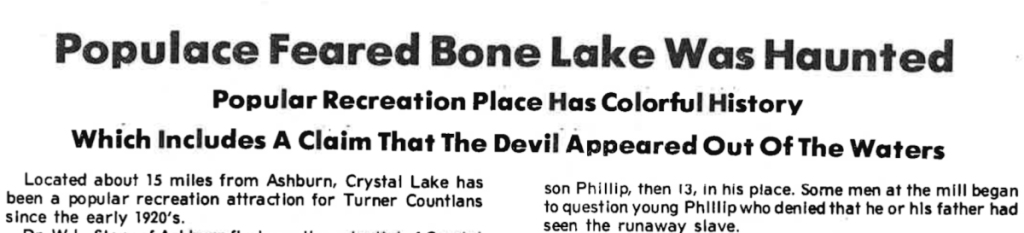
An article by Thom. Kolesa in the Turner County Diamond Jubilee publication (October 1980) features the myths and legends of Crystal Lake.
Crystal Lake rises and falls again as scary tales abound
According to Thom. Kolesa’s article, “Dr. W.L. Story of Ashburn first saw the potential of Crystal Lake as a place for adults and young people to enjoy swimming, camping, and other outdoor recreation.”
In the 1920s, investors renamed the 100-acre natural resource from Bone Pond to Crystal Beach or Lake. They opened the lake to area residents as a water park with swimming, dancing, bowling, skating, water slides, and more. The lake had crystal clear water with a beach consisting of more than a mile of beautiful white sand.
According to Kolesa, “Crystal Lake’s popularity has risen and fallen like the underground springs that feed it. At first only the natural lime sink ‘lake’ was available; later, as the property changed hands, the native white sand beaches surrounding the lake were rebuilt, a pavilion was built, and the recreational facilities were expanded.
“From the 1920s through the 1930s, Crystal Lake enjoyed fluctuating success. In the 1940s, the lake fell into disrepute and soon became a ‘ghost’ resort place with abandoned camping cabins, a pier, and little activity in the pavilion’s bowling alley or skating rink.
“In the early 1920s was when the myths and legends about Crystal Lake first emerged.
“In those days, many Turner Countians believed that Crystal Lake was haunted; that the Devil on more than one occasion had risen out of the ‘bottomless pit’ where property developers had tried to cement the limestone outlet where water from the lake flowed into underground streams and eventually into the Alapaha River, which flows partly underground through South Georgia into the Suwannee River.”
One summer night in the 1920s, a party on the shore broke up in hysteria when the revelers believed they saw the Devil himself rise up from the lake’s depths (that must have been some awesome shindig!). “On one particular summer night,” Kolesa writes, “young men and women, enjoying a party on the sand, were paralyzed with fear when they claimed to see the Devil rise from the deepest part of the water. True or not, they were so convincing, that the lake began to be much less popular.
“Also in the middle 1920s, reports circulated that thousands of moccasins were in the lake, a claim that may have had some truth in it since it was almost abandoned.”
The storytellers say several people drowned in the lake and it was bottomless at the deep end, twisting down into dark underwater caverns. (One account was that a scuba diver went down and never came back up.)
However, according to the USGenWeb Archives, while apparently supported by hidden underground streams, the lake was at most 75 feet deep in the deepest area (which is still surprising for a body of water in South Georgia). Owners over the years tried to cement the limestone drain that emptied the lake underground occasionally into the Alapaha River.
Crystal Lake reaches peak of its fame, and then dies
According to Brian Brown’s Vanishing Georgia article, “Mandy Bryant notes that her grandfather Leon Lewis and Jehu Fletcher owned Crystal Lake for awhile in the 40′s and 50′s. My grandfather died in 1953, and at that time my mother (Athleen Lewis Harp) and her sister (Maudine Lewis Holden) bought Jehu Fletcher’s half. Then the three sisters sold the property. The late A. N. Adcock, Jr. of Tifton, who was one of the greatest promoters of tourism in the region, was the owner who expanded and popularized the park.” The owner began marketing the resort in newspaper ads and on bumper stickers that were put on teenagers’ cars and pickups across South Georgia.
It appears that Crystal Lake’s reputed “curse” finally caught up with the tourist destination circa 1998. The families of a couple of youths who did drown in the lake sued the resort. Attendance plummeted as South Georgians pursued other newer entertainment venues. The cost of maintaining the lake, ensuring it was full for water recreation, and insuring the business
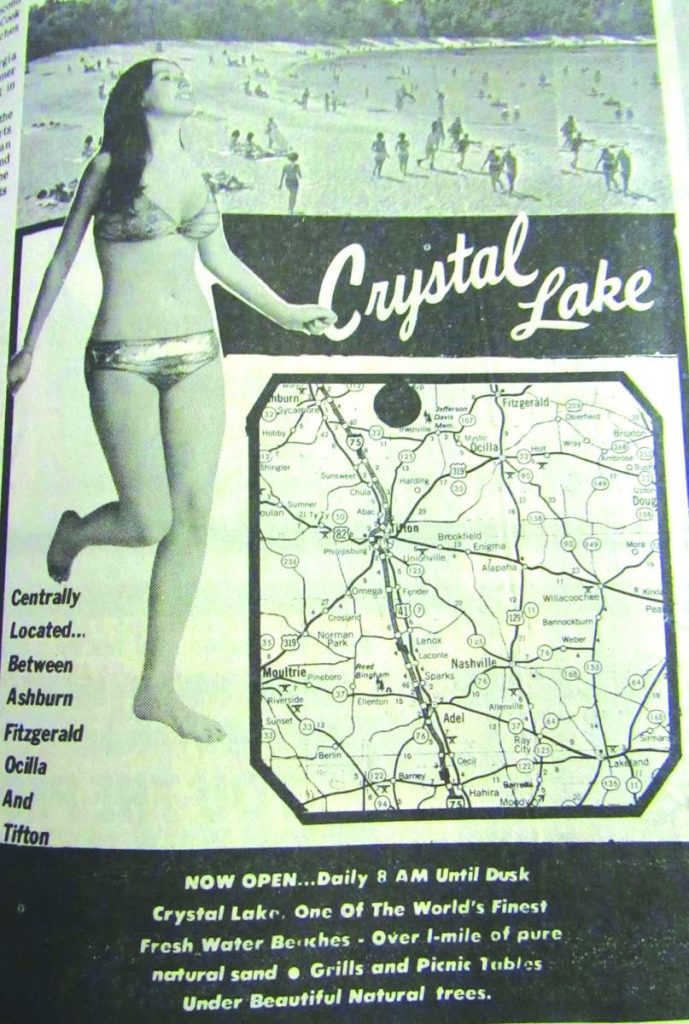
An ad for Crystal Lake that appeared in 1976 issues of The Adel News and other area newspapers.

An old 4th of July newspaper ad for Crystal Lake. Fireworks!
became too high. The resort finally closed to the public.
Crystal Lake “is completely dried up today and is no longer open to the public,” Brian Brown writes. “It is now used as a hunting club.
“The Adcock family has done a great job in regard to its general preservation, as the surrounding hammocks and scrublands are ecologically important habitats. I was fortunate enough to go riding in the woods at Crystal Lake with Mr. Adcock, along with my father and the late Milton Hopkins, in search of a rare bird whose identity I can no longer recall. It was probably around 1989, and even then at the height of the park’s popularity, Mr. Adcock was deeply interested in preserving the natural history of this Special Place. The owners bought Holiday Beach in Douglas, Ga. The name changed from Crystal Lake to Crystal Beach after they closed Holiday Beach down and moved the big slides and other stuff to Crystal Lake. Unfortunately, as of 2015, much of the property has been clearcut.”
Today, the water slides and beach pavilion rust and crumble silently, alternately baked by the pitiless Southern sun and battered by storms. The lake has dried up, leaving behind what resembles a desolate moon crater surrounded by heavy brush in the most recent aerial photos I have seen online. I would think that the water needs of agriculture irrigation and encroaching residential development, as well as successive years of drought, have massively staunched the flow from underground springs to the lake.
The owners now use the area for a hunting club, and no trespassing is allowed.
I imagine if anyone who knows the water park’s story were allowed to visit the ghost resort Crystal Lake at dusk, and wants to feel a true haunting, he would still hear the faint echoes of children’s laughter and see the dim outlines of swimmers splashing in phantom waters from a long time ago…
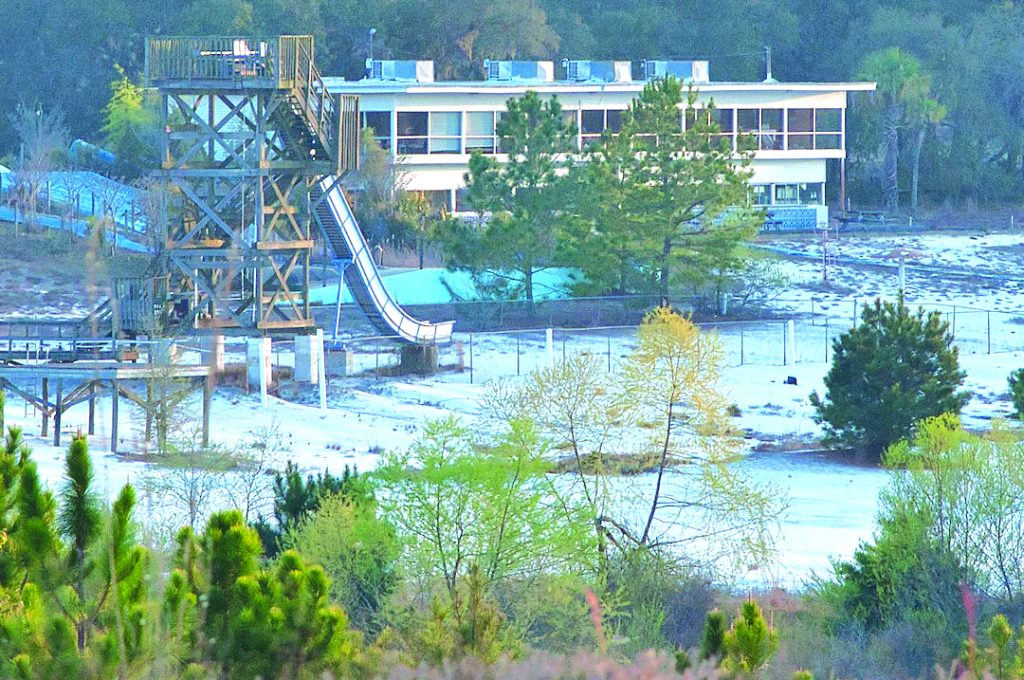
Crystal Lake, years after the closing. Photos Source: Brian Brown, Vanishing Georgia; vanishinggeorgia.com. This website has several historic photos from Crystal Lake’s heyday to appeal to everyone’s nostalgia about that special place, as well as heart- wrenching scenes from after the resort’s closing. Vanishing Georgia also features many other landmarks of the Peach State. Please do not use the photos or information without written permission from Vanishing Georgia.
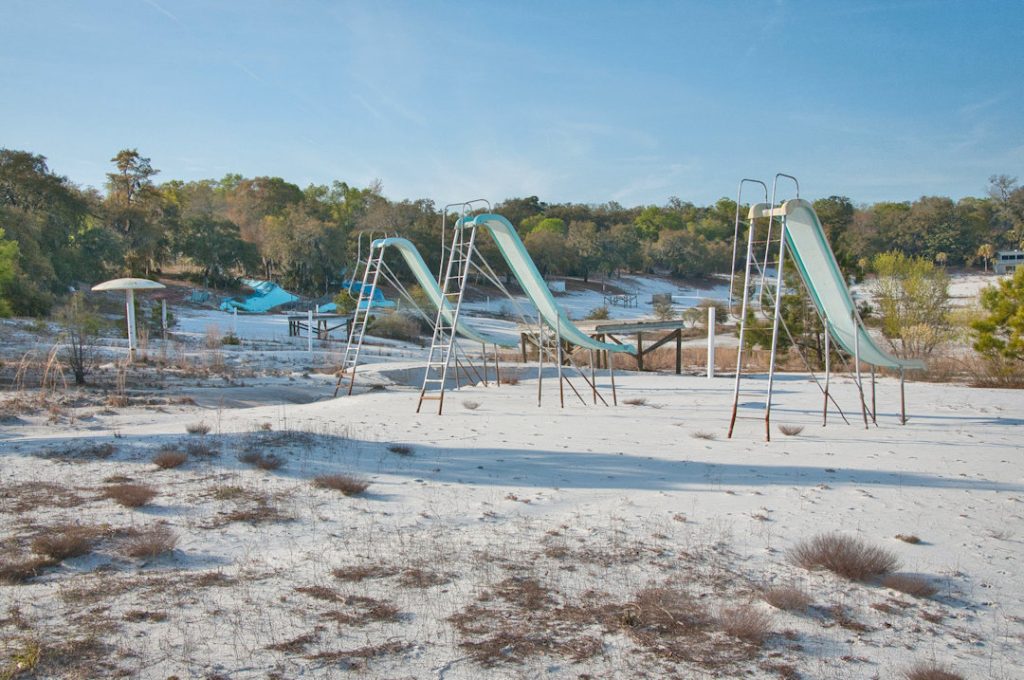
Brian Brown
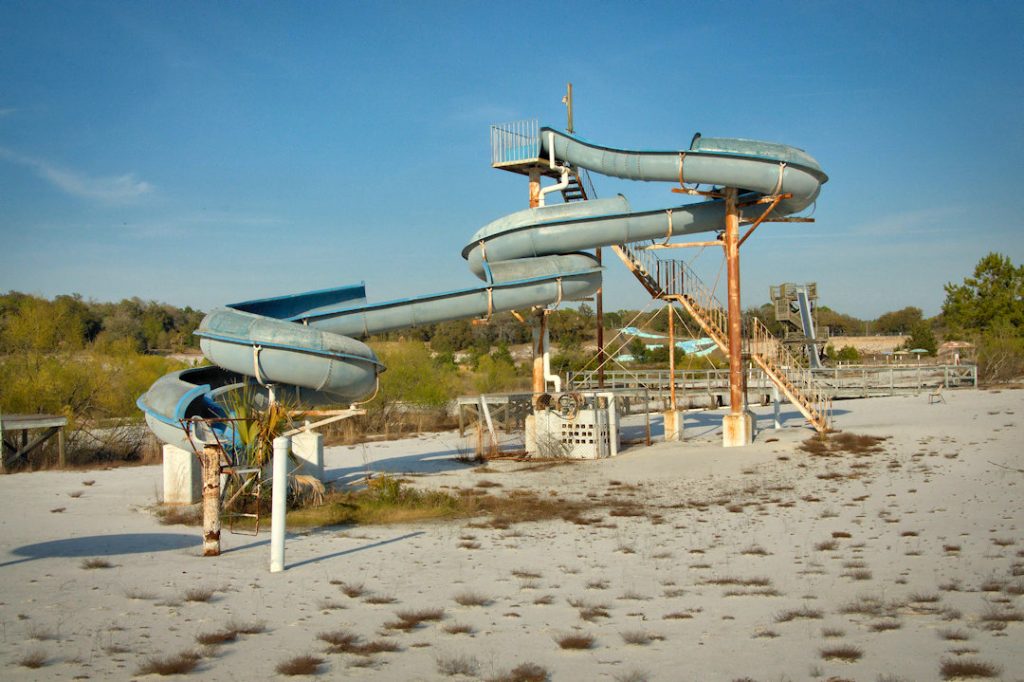
Brian Brown
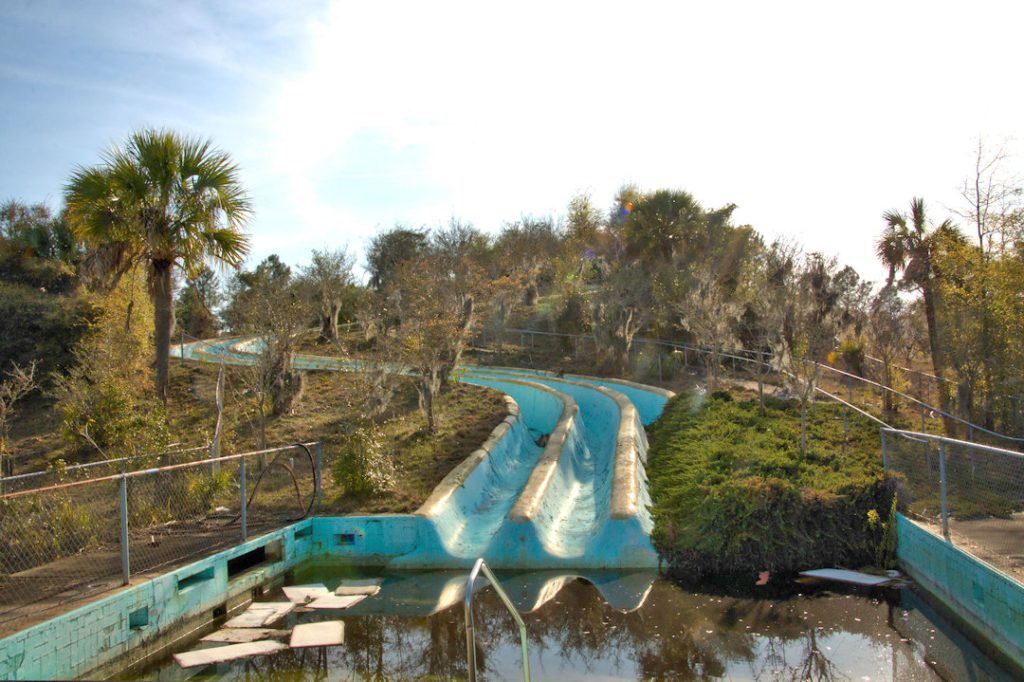
Brian Brown
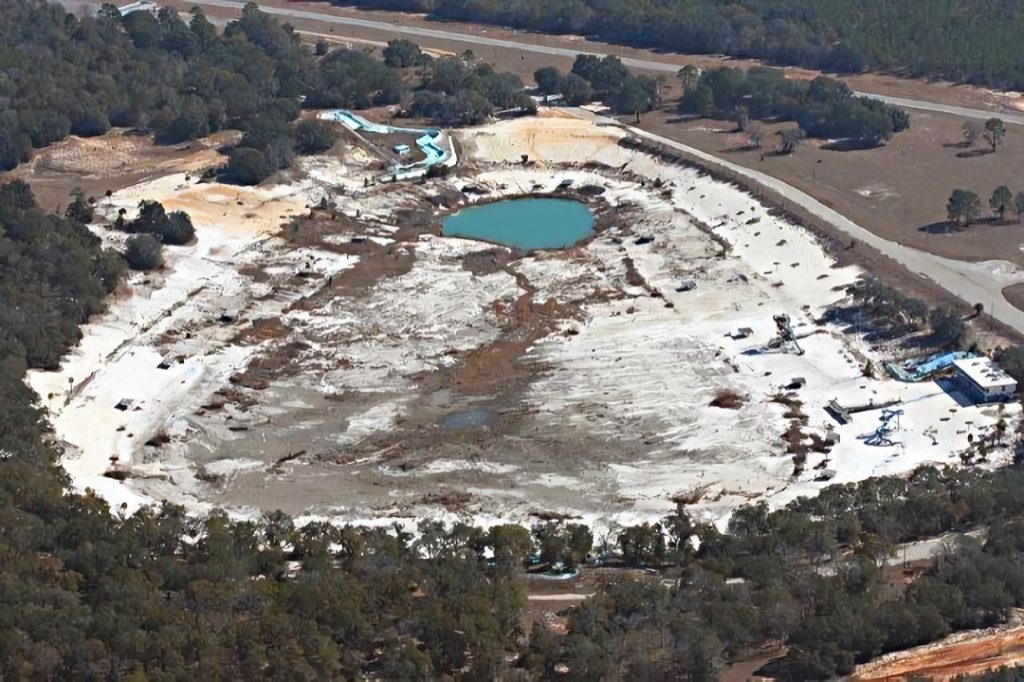
Browne Harper, aerial photo of Crystal Lake circa 2008, on Vanishing Georgia website.