
The Legend of Lo-Eyes, Part 1: The Battle of Brushy Creek
By Charles Shiver
In July 1836, Georgia militia and local armed citizens engaged the Creek Indians in the Battle of Brushy Creek.
Skirmishes broke out across South Georgia. A fight occurred along the banks of the Little River and Warrior Creek, between what is now Cook and Colquitt Counties. Some believe the lake at Reed Bingham State Park now covers this battleground.
Did you know the original Creek Indian name for the Little River was the Ockolocoochee River (source: WWALS Watershed Coalition), or possibly the Ocklachoochee River (source: Cook County Historical Society)?
The meaning of “Ockolocoochee” in English may be lost in the depths of history. There does seem to be some power in the mystical, timeless, original “true name” of a place.
I respect the Native American culture, but I am not woke, thus I suggest keeping to the “Little River,” which rolls better off the tongue and is better for signs and maps.
Of course, there is more to the story!
The late Dan Cowart, a local researcher and former Cook County Probate Judge, wrote in the 1993 “Accent” issue of the Adel News Tribune that the Battle of Brushy Creek “proved to be the beginning of the end of Indian habitation in this immediate area.”
According to Miss Minnie Shaw’s History of Cook County, Volume One (written 1930-32, amended 1965, and published 1984):
“Scarcely had the people of the present county gotten into forts and formed companies for fighting when the hostile Creeks and Cherokee Indians, coming from the North to join the neighboring Seminoles in Florida, began murdering families along the way.
“The soldiers of the Hamilton Sharp [or Sharpe] Company at the McCranie Fort [where the George Moore farm was later located a century later] looked out one morning about the 10th of June 1836 and found the woods just across the Musket Branch from their camp, literally full of Indians. They saw they were so completely out-numbered that they sent Mr. Ashley Lindsey through the country to the Morrison Fort [later to become John Rountree’s old field] to get aid from Pike’s Company.”
War in the deep woods and swamps was a nasty, brutal affair. The Indians ambushed scouts sent out from the McCranie Fort at Brushy Creek.
According to Miss Shaw’s book, “While he was gone for help, Hamilton Sharp [or Sharpe], Captain of the McCranie Fort, sent out Robert N. Parrish, Richard Golden, Penuel Folsom, and William McCranie as scouts to guard the Indians until help could come. The Indians out-witted the scouts and decoyed them away from their camp and attacked them.
“They wounded Robert N. Parrish and Penuel [or Pennywell] Folsom [who was only 26 years old]. Folsom was mortally wounded and just as the Indians got to him to scalp him, Pike’s Company came up in the rear, began firing and the Indians fled across Brushy Creek.
“The companies were all soon united and together they pursued the Indians, killing men, women and children. Numbers of Indians were killed that day. …”
Penuel Folsom was buried in what is now known as Evergreen Baptist Church Cemetery (originally Rountree Cemetery), his being the first grave in it, according to Judge Cowart’s account.
Having followed a trail for three miles down the Little River, Enoch Hall’s battalion of 31 men encountered about 60 Indians. The battalion fought the Indians and lost one man with another one injured. “The militia retreated but was soon tracking the Indians again,” according to the 1997 book Touring the Backroads of North and South Georgia, by Victoria and Frank Logue. “[The militia] then met the Indian party at a boggy meadow in front of a cypress pond, and the ensuing battle lasted two hours.”
The Indians were eventually routed during the battle at the pond, Touring the Backroads states. “Enoch later recalled ‘to be sure, it was the hottest day he had ever seen.’
“Enoch remembered that as he and his men fought in Brushy Creek Pond, the pond became streaked with blood. But he was ‘so hot, so perished for water, that he stooped down and got a mouthful.’
“He later joked that he had Indian blood in him.”
The militias eventually caught up with a group of the fleeing Indians at Cow Creek, south of Milltown (later Lakeland) in present Lanier County, where another battle was fought, resulting in a complete rout of the Indians. “[They] hurriedly headed southward, evidently for Florida,” Cowart wrote. “In this battle, one of the Indians’ biggest warriors was killed.”
The settlers were compassionate enough to allow a young Indian maiden who had been captured to yell out that night, and she was released to her mother, who came out of the darkness in response to the cries.
“To the astonishment of the settlers, when morning came, every Indian corpse that could be found had his or her hands folded and each lifeless body had been straightened, but not buried. Their bodies were never buried,” Cowart wrote.
J.J. Parrish wrote in his book published in the 1960s,
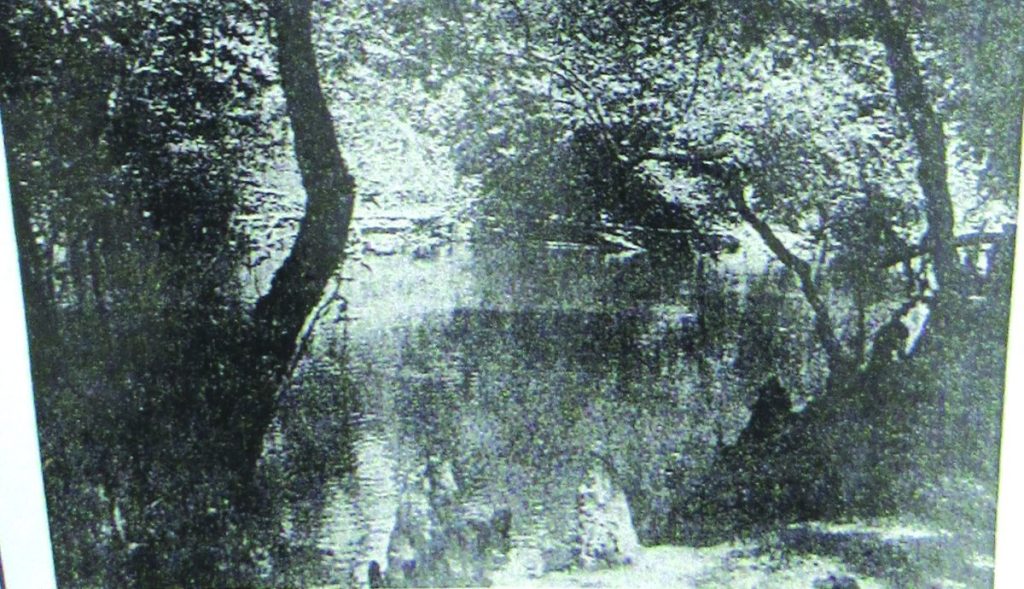
A photo with the flash line “Battlefield, Now A Park,” from the 1965 “Diamond Jubilee” Issue of The Moultrie Observer, as displayed at the Colquitt County Museum of History. The state park lake has now covered the site on Little River where one of the last reported pitched battles with Indians occurred in this area. Here, between the Moultrie-Adel Highway and where Warrior Creek merged with Little River, was the spot where militia crossed in hot pursuit of an Indian band in 1836. The picture was made before the dam was constructed across Little River to form the 375-acre lake, now Reed Bingham.

The clothing that would be worn by a Georgia militia member during the Indian Wars of the 1830s. This outfit is on display at the Colquitt County Museum of History.
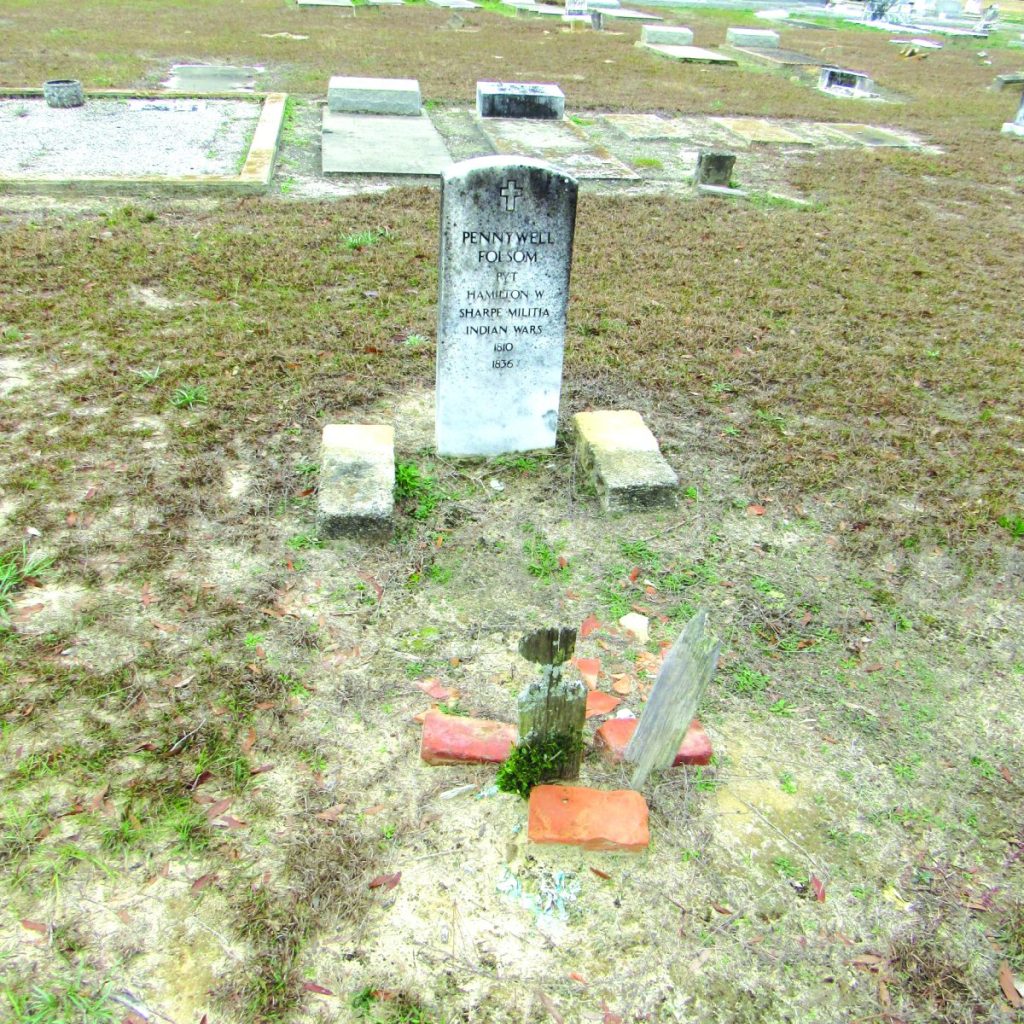
“This is a memorial marker placed by our Brushy Creek Chapter Daughters of Indian Wars” in Evergreen Baptist Church Cemetery near Adel, says Linda W. Meadows, also with the Cook County Historical Society. “Pennywell/Penuel [Folsom], was killed in the Battle of Brushy Creek, July 1836. He was a very prominent landowner in South Georgia, and beyond.”

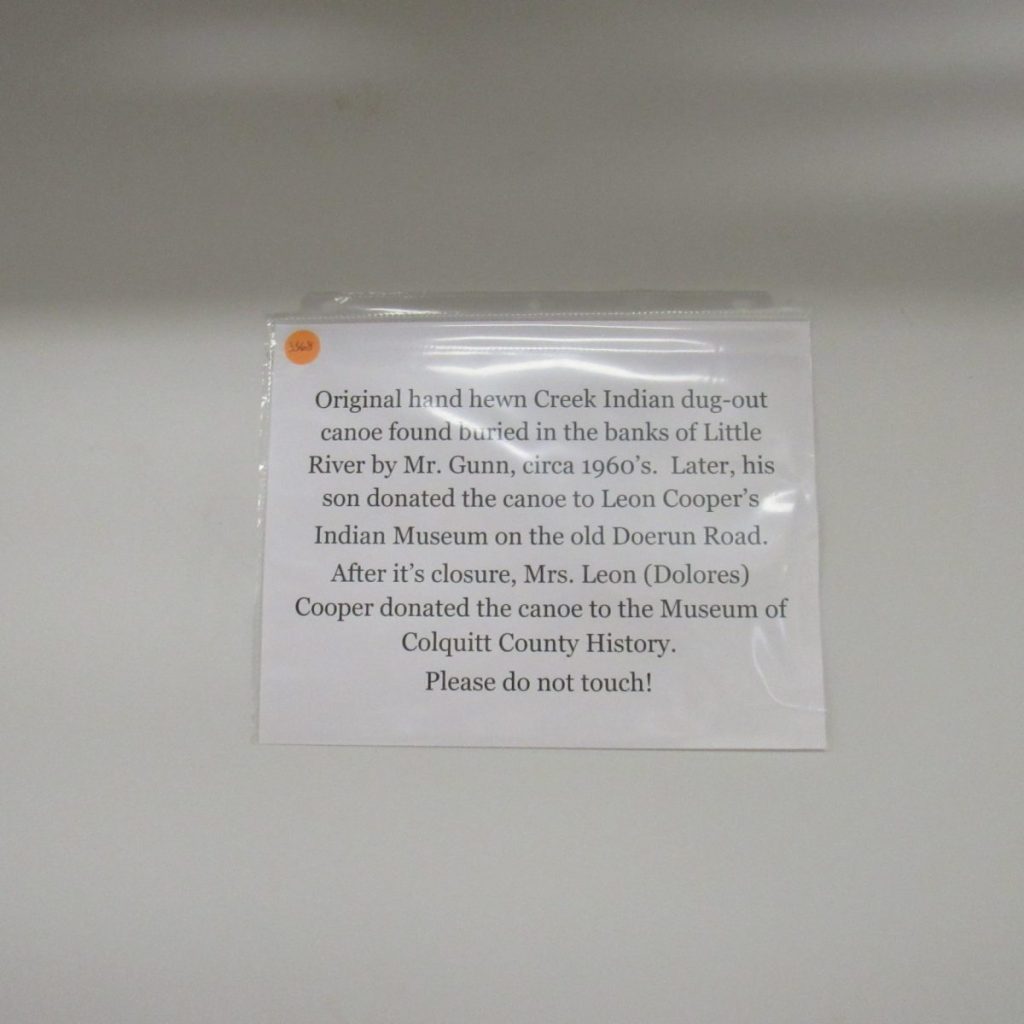
I visited the Museum of Colquitt County History to research this column. I appreciate Mrs. Faye Bridwell’s help. Here is just one of the unusual artifacts on display – a Native American canoe found buried in the banks of Little River.
[the following language is in keeping with the time of publication]: “There is absolutely no way to determine the final results of the Brushy Creek Battle. No way to determine the total number of Indians taking part. One report stated there were 22 Indians and two negroes killed [the latter apparently being runaway slaves who joined the marauding group], many wounded, and 18 women and children taken prisoner and taken to the Thomasville Jail. The casualties among the Militia and Volunteers [are] likewise impossible to determine, for no accurate records were kept by anyone.” In addition to Penuel Folsom, other known casualties were James Therrell, Edwin Shanks, and Edwin Henderson, all three being members of Pike’s Company.
Indian survivors of the battle were rounded up and marched to jail in Thomasville until they were relocated out West.
As late as the 1850s, a Thomasville newspaper was carrying an ad by Capt. Casey, a Florida Indian Agent, in which he offered a bounty for the capture of live Indian warriors, $250 to $500; $15 to $200 for Indian women; and $100 to $200 for Indian boys over 10. That was a fortune in those days.
The Battle of Brushy Creek was a triumph or tragedy, depending upon your perspective. Most people these days would consider “The Trail of Tears,” in which the United States forced the Indians – or Native Americans in modern parlance – to move West from their ancestral lands and chased some on the warpath down to Florida, as an atrocity. In those days, however, the forced deportation of the Indians was seen as reasonable. In fact, both sides committed atrocities. The Indians that settlers fought here had been part of a main group from Alabama that decimated the small village of Roanoke in present day Stewart County, Ga., on Sunday, May 14, 1836. J.J. Parrish wrote, “… [They] made quick work of completely destroying every home and store, pillaging and burning everyone of them. The population, men, women and children, were killed and scalped, armed and unarmed alike. This small Chattahoochee River Valley settlement was virtually wiped off the map. …”
However, acts of great compassion also marked those dark days, and the positive impact may still be felt in our modern times, as I will show you in the second part of this column.
TO BE CONTINUED – “War is Kind”