Fate of the I-75 Rape Gang
 By Charles Shiver
Did you know back in 1973, a Cook County Superior Court judge and juries sentenced three defendants in the same rape and kidnapping case to death in the State of Georgia’s electric chair? And all three monsters were put on Death Row less than six months after they had committed the offenses?
Judge H.W. Lott either affirmed the death sentence verdicts by the juries or ordered the ultimate penalty.
The case came after an extensive investigation by Sheriff D.J. Connell, Chief Deputy J.W. Snead, and Division of Investigation Agent Harold Greeson.
According to an Adel News article from Aug. 1, 1973, on the evening of July 13, 1973, three Tifton men stopped for a 25-year-old Port Orange, Fla., woman who had a flat tire on her car on I-75. They forced her in their car, beat her, and took her to a wooded area just off the Sparks-Moultrie Cutoff Road, and all three raped the woman. According to the statement of facts in the case, the offenders used racial slurs against the victim and dragged her across the asphalt road. The assault occurred while she was lying between two stumps infested with large red ants known locally as “cowboys.”
The victim was severely beaten and required two days’ confinement in the local hospital to recuperate. The victim escaped from the trio and made her way to a trailer park nearby to notify officials. The three men were charged with kidnapping and rape.
A second related incident occurred July 24, 1973, and involved the three counties of Cook, Colquitt, and Tift. In that incident, a Ft. Pierce couple were picked up as hitchhikers just south of Tifton on their way to Adel. They wanted to be put out at a truck stop near Adel, but the two men pulled guns on the couple and made them stay in the car.
They then drove to a service station at the Barneyville Exit and bought some gasoline before driving to a wooded area in Colquitt County, where the 23-year-old woman was raped and both victims were robbed and left stranded.
The hitchhikers walked all night until they managed to get back into Cook County, where a resident found them and directed them to the Sheriff’s Office. The two offenders were apprehended later in the week. Officers used an extremely detailed description of the men and automobile from the service station attendant.
The investigation led to the arrests of three others involved in the July 13, 1973, incident. Sheriff Connell told the Adel News at the time, “They had been riding up and down the interstate looking for women.” DOI Agent Greeson told the Adel News that several reports had been received during the past few months of a “gang-like” operation with members preying on hitchhikers and stranded motorists. “There have been similar reports lately on the stretch of I-75 between Tifton and Adel,” the agent said. “There’s no telling how many incidents have occurred that were not reported.”
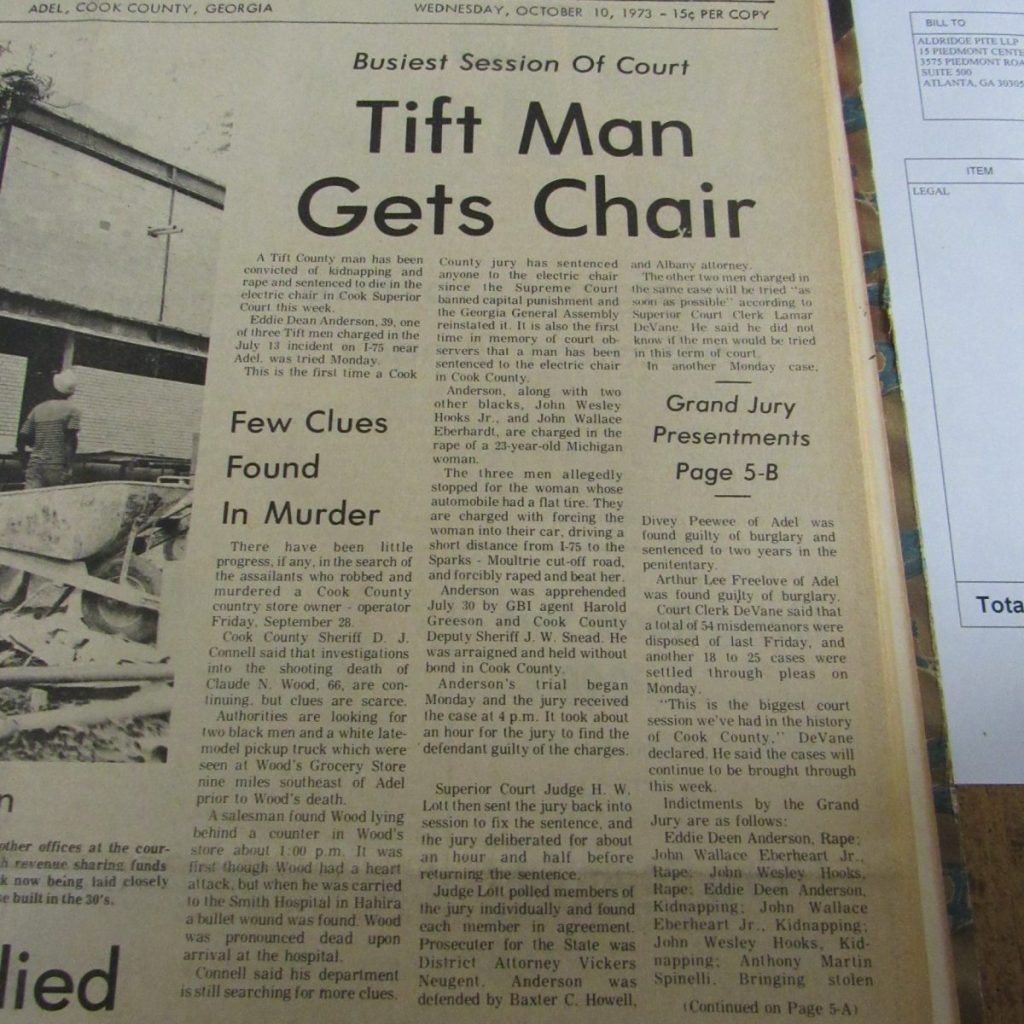
Less than two and a half months later (the wheels of justice turned much faster in those days – the volume of cases was much less than now, and the courts didn’t allow defense attorneys a lot of leeway with delaying motions), a jury convicted one of the Tifton men of kidnapping and rape and sentenced him to die in the electric chair. It took about an hour for the jury to find the defendant guilty of the charges. Judge H.W. Lott presided over the trial. D.A. Vickers Neugent prosecuted the case, and Albany attorney Baxter C. Howell defended the offender. The article in the Oct. 10, 1973, Adel News issue is nonchalantly headlined, “Busiest Session of Court – Tift Man Gets Chair.”
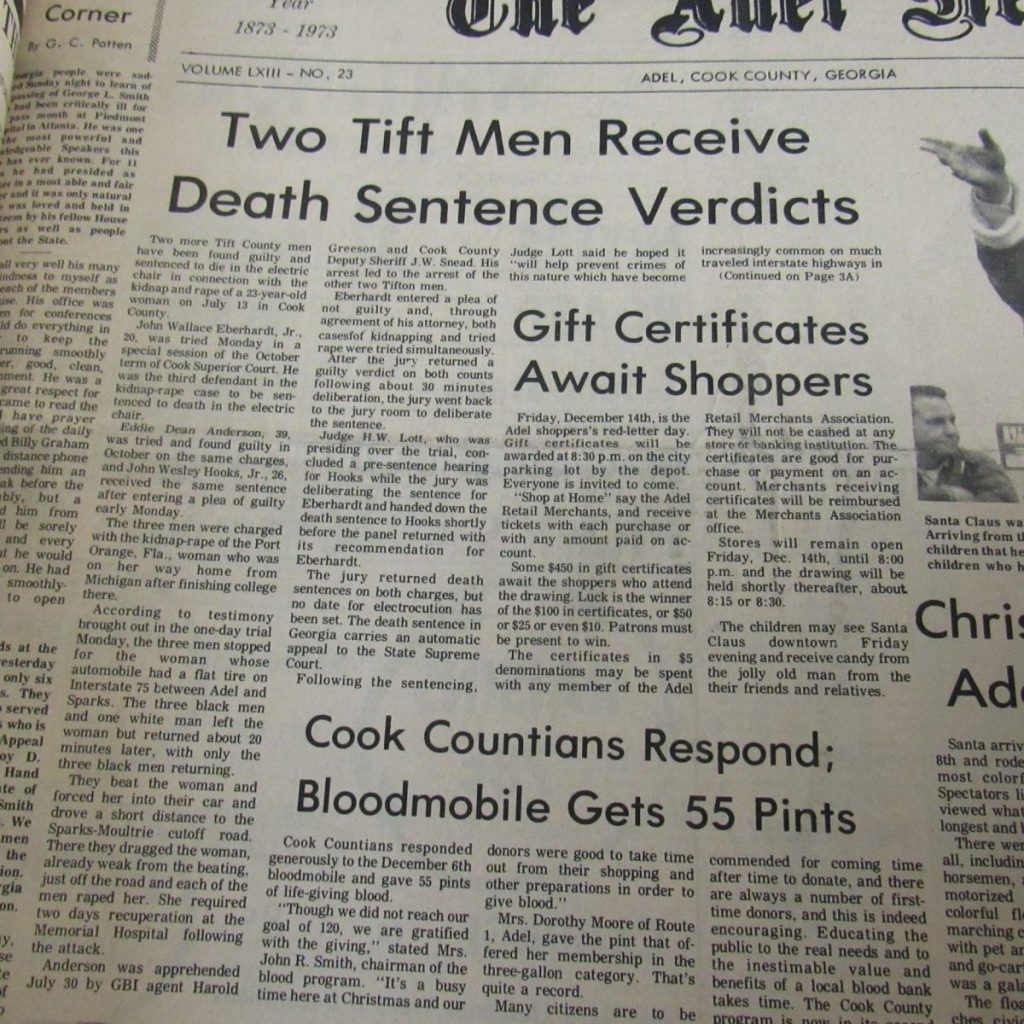
An article in the Wednesday, Dec. 12, 1973, issue of the Adel News is headlined (next to a photo of Santa Claus waving at the annual Adel Christmas Parade! – the front pages of good newspapers have always been a bit split-minded due to serving as true mirrors of their communities), “Two Tift Men Receive Death Sentence Verdicts.”
One of the defendants was tried, found guilty (following about a half hour of deliberation by the jury), and sentenced to the electric chair. The other defendant received the death sentence after entering a guilty plea.
Following the sentencing, Judge Lott remarked that he hoped it “will help prevent crimes of this nature, which have become increasingly common on much traveled interstate highways in Georgia.”
During the previous week that same late fall, the energy crisis forced Cook County residents to have “the first gas-less Sunday.” Locals were staying off the road, as nearly all the gas stations in the county were closed. The Board of Commissioners passed a resolution urging “all citizens to cooperate, each doing his part to conserve energy, since it is essential for the welfare of the United States and the State of Georgia. … It is suggested and strongly urged that all conserve energy in any reasonable way possible. It is recommended that all speed limits be strictly enforced; that thermostats be lowered in public buildings and homes; that all but security lights be eliminated after work in public buildings; car pools are encouraged as a means of conservation; that no one drive over 50 miles per hour.”
We gripe and complain so much in 2026. Younger people these days have no idea what hard times were really like.
Anyway, the rape gang defendants appealed their death sentences to the Georgia Supreme Court. Among other arguments, the defense attorneys maintained that the Grand Jury excluded blacks and women and the judge erred by not declaring the death penalty “cruel and unusual punishment,” in violation of the U.S. Constitution.
However, the Georgia Supreme Court justices – with one dissenting judge, Gunter – affirmed the death sentences in Superior Court. “We have compared the evidence and sentence in this case with other similar cases and conclude the sentence of death is not excessive or disproportionate to the penalty imposed in those cases,” the justices stated in one decision.
It appears, however, the gang members were not electrocuted after all.
According to the Death Penalty Information Center, “in 1977, the U.S. Supreme Court in Coker vs. Georgia, 433 U.S. 584, held that the death penalty for the rape of an adult was ‘grossly disproportionate’ and an ‘excessive punishment,’ and hence was unconstitutional under the Eighth Amendment. The Court looked at the relatively few states that allowed the death penalty for rape and the few death sentences that had been handed down.”
You could only hope that the thugs in the Cook County case spent the rest of their lives in prison. Was the electric chair, and is death by lethal injection, a deterrent for murder and other inhumanly vile offenses? Judge Lott, by his own words, certainly felt that way about the chair.
Two pearls of wisdom I have learned from deep research of South Georgia’s history:
• Wonderful events have occurred, and there have been wonderful people. But it is a big mistake to consider that entire history through the rose-colored glasses of overly indulgent nostalgia.
• Newspapers were thousands of times more graphic in their coverage of crimes and tragedies than today’s news media. That might not have been a good situation. Still, people seemed to stand stronger while enduring danger and hardship than they do now, and appeared to be a lot tougher. I believe Stephen King once described their condition as “living cheek by jowl with Death.” Hopefully, we can still learn much from those hard-as-hickory-wood past generations of Southern folks.