
The death penalty in Cook County, Ga.
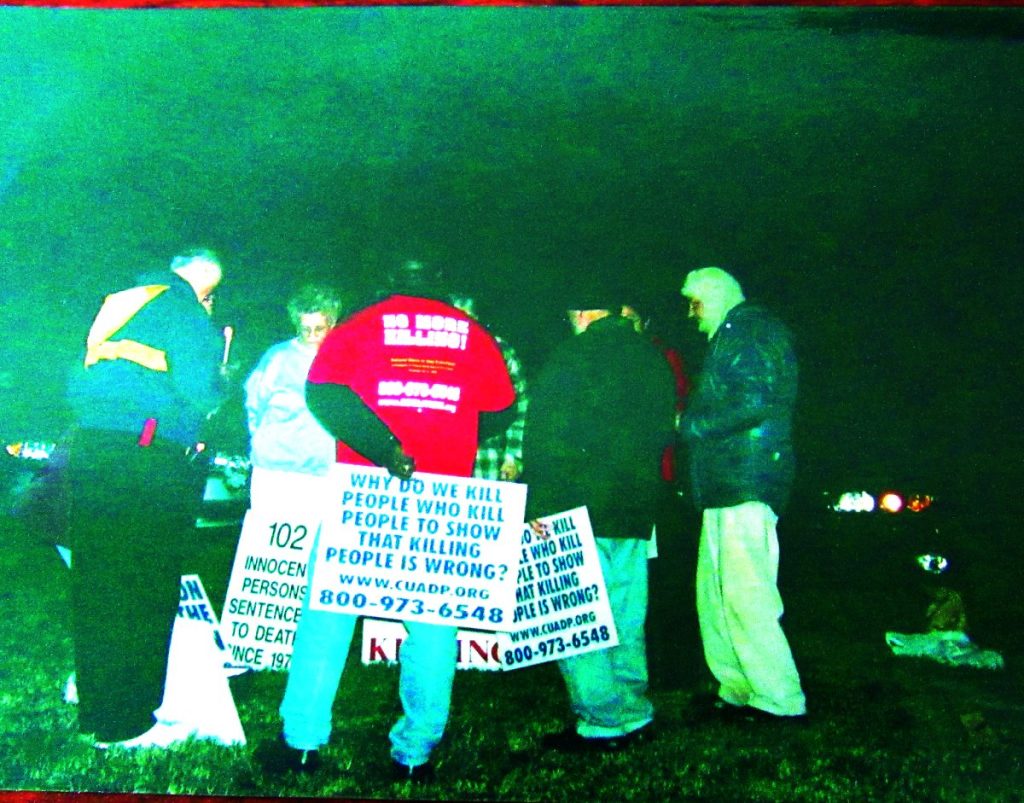
Death penalty protesters pray after the Nov. 13, 2002, execution (by lethal injection) of William Howard Putman, 59, at the Georgia Diagnostic and Classification Prison in Jackson, Ga. I do not necessarily agree with the demonstrators’ opinions, but it is my hope that this photo I took after witnessing Putman’s execution will be of historical interest one day. My late wife Mary Ann traveled with me to Jackson to provide moral support even though she couldn’t be a witness to the execution. Always empathetic, she knew what impact watching a man die, no matter how wicked he was, would have on me.
By Charles Shiver
I drove through Sparks down a back street due to a detour one morning last week. I saw where what I believe was a club where the owner was stabbed to death with an ice pick years ago is now a daycare center.
I remembered the store in Adel where the owner and his employee were beaten to death with baseball bats during a robbery years ago is now a Spanish-language church.
Hopefully, all the joy there now will lay to rest any lingering negative energies from those atrocities. Those settings bring to mind the Biblical reference of “swords into plowshares.”
But it’s sad to carry around knowledge of those old living nightmares. I suppose many others have the same memories brought to life when they see such places with new faces …
The judges in those murder cases sentenced the killers to life in state prison without the possibility of parole. However, thinking about those grave matters leads me to my research into cases from the dark side of local history where the ultimate penalties were in fact imposed by the State.
Did you know three defendants from local (in-county) cases have been executed since the founding of Cook County over a century ago?
I have researched the history of lawful executions back to the days of the early 20th century when Cook was still part of Berrien County. According to The Historical News, the gallows located in the old Berrien County Jail, built 1901-1903, were “only used two times before capital punishment ceased to be administered by the individual counties.” As best as I can tell, the Berrien County Jail hangings involved a defendant from Adel and a defendant from Lenox, communities that are currently a part of what is now Cook County.
The first execution involved the murderer of Adel Town Marshal William A. Hyers in 1902: Boisy Bryant, 17, who shot the marshal in the abdomen during an arrest attempt in Adel. Bryant was hanged on Sept. 12, 1902, inside the uncompleted Berrien County Jail.
Bryant was not the only killer from what is now Cook County to plunge into eternity at the end of a rope at the old Berrien County Jail. Warren Robinson’s excellent book Death Waits at the Depot details the story of Marshall Lewis, who murdered Clifford Rutherford during a burglary in Lenox. Death Waits at the Depot states, “Almost seven years later [after the Bryant execution] on the appointed day of July 9, 1909, Marshall Lewis was the last person executed in Berrien County when the trapdoor was released and his body dropped through the space below.”
The first person who was literally a Cook County resident to be lawfully executed was Will Lacy, 41, on May 21, 1937, according to the Georgia Department of Corrections. Lacy was dispatched in the electric chair at Georgia State Prison in Milledgeville. That was a two-for-one special, with Eli Melton, 34, from Muscogee County electrocuted the same day for rape.
According to the book Legal Executions in Georgia: A Comprehensive Registry, 1866-1964 by Daniel Allen Hearn, Will Lacy a.k.a. “Will Brown” committed a double murder on July 6, 1935, in Cook County. Lacy committed the shotgun slayings of a mother and her daughter, Donie Lockhart Mitchell, 49, and Nellie Ruth Harris, 26. The motive was personal problems, but the exact details are obscure. The Adel News reported on the case in the July 12, 1935, the May 7, 1937, and May 28, 1937 issues.
The next convicted murderer in a case from Cook County to be executed was Albert Parker, 29, who was electrocuted on Dec. 13, 1946, in the chair at Georgia State Prison in Reidsville. Parker was put to death for the murder of Marcus Lee, a 71-year-old man who was hacked to death with a sharp-edged hoe. The crime was committed on Oct. 27, 1946, actually in Berrien County, but the court granted a change of venue to Cook. The motive for the Lee murder appears to have been robbery.
The third Cook County-related execution was nearly 60 years later. On Nov. 13, 2002, I was a media witness to the execution by lethal injection of William Howard Putman, 59, in Jackson, Ga. Putman, an Alabama truck driver, had been convicted of the July 10, 1980, murders of 49-year-old school teacher William Gerald Hodges at a Valdosta truck stop and a Bardstown, Kentucky couple, David N. Hardin, 22, and his wife, Katie Back, 28, in a rest area off I-75 near Lenox. The couple had their three children and Hardin’s niece in the back seat of their car when the husband and wife were shot and killed. They had been returning home from a Florida vacation.
Superior Court Judge W.D. “Jack” Knight sentenced Putman to death.
I wrote a few articles and took some photographs back in the 1990s with Judge Knight.
I remember him as being a nice man to his friends and family, but a stern disciplinarian for convicted criminals. He should be a role model for others working today in the Alapaha Judicial Circuit.
I would like very much to read his publication, “State of Georgia Vs. Lady Justice,” in which he describes the three death penalty cases over which he presided. The title seems telling, doesn’t it?
In news reports, Judge Knight expressed frustration that he had retired and so many years had passed prior to Putman’s execution. This may appear cruel, but my only further comment on the case at this point is I have seen good people suffer much more before dying than Putman apparently did.
Judge Knight passed away at the age of 75 in 2009.

Judge W.D. Knight