
Remembering the Fellowship Children
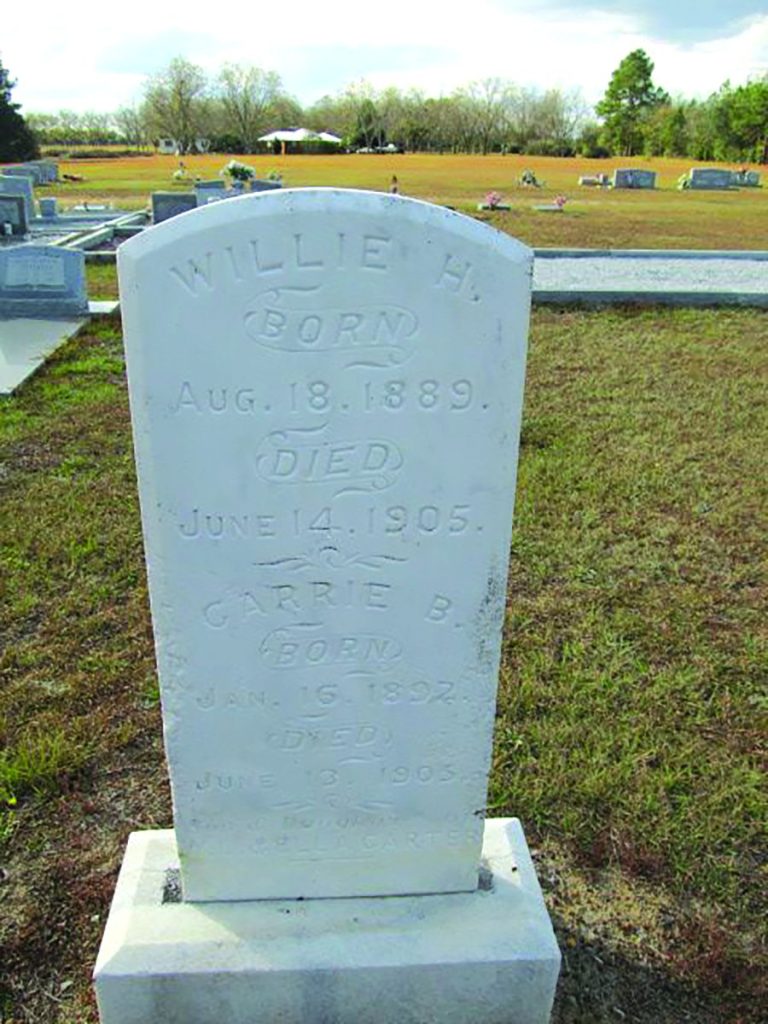
The double grave of Willie Carter, 15, and his sister Carrie, 13, in Fellowship Church Cemetery near Cecil.
Remembering the Fellowship Children
By Charles Shiver
How did the Valdosta newspaper become a daily publication? The answer is literally buried in the earth of Cook County. It’s just one of those shadowy historical facts which so many people have forgotten.
One who hadn’t was the late Albert Pendleton, archivist/historian of the Lowndes County Historical Society and Museum. Back in the late 1990s, he helped me research the mysteries of the Rawlins-Carter murder case.
In June 1905, the Carter children – Willie, 15, and Carrie, 13 – were shot and killed just before dusk outside their home near the Clubhouse District in the north part of Lowndes County. The children are buried in the same grave in Fellowship Baptist Church Cemetery near Cecil.
The killings resulted from a violent feud between their father W.L. Carter and his neighbor, Joseph “Crazy Joe” Rawlins. In fact, a headline of the time in The Atlanta Constitution read, “Old Feud Ends Children’s Lives.”
The public’s appetite for information about the murder trial was insatiable. “The people in this area wanted news daily of the trial,” Pendleton said, adding that the Valdosta Times changed from a twice-a-week newspaper to a daily with coverage about the case. Trains, booked for excursion trips, took several thousand spectators to Valdosta for the trial. The papers made Rawlins one of the most quoted condemned men in state history.
W.L. Carter and Rawlins became mortal enemies while living near one another in Coffee County. One moved to Lowndes County. The other moved to Jacksonville, Fla., and then moved to Lowndes, where he found himself again a neighbor of his foe. What makes the hatred between them even sadder is that they were both Baptist ministers.
Pendleton said his research showed that Rawlins attempted to assassinate W.L. Carter prior to the attack on the children. “Rawlins [or a hired assassin] shot Carter in the leg or foot while he was riding in a wagon and left him for dead,” Pendleton said. “But Carter survived.”
Rawlins had three sons he controlled. Pendleton said one or two of them shot the children while the rest of the family was inside the Carter home. The children apparently had gone outside to doctor a sick calf. The girl was killed outright, while the boy made it back to the house, but died during the night. Willie’s younger brother was also shot, but he survived.
On the day of the shooting, Rawlins made a point of riding a train to Valdosta and going everywhere in town so people could see him and give him a good alibi, according to Pendleton.
It didn’t work.
Rawlins was tried for the murders, found guilty, and hanged in Valdosta. He “is buried at Blockhouse Church Cemetery near Jacksonville, GA,” according to Catherine Fussell Wells. “The inscription on his headstone reads: ‘This bark was well built, but misguided, ran swift on the rocks of destruction.’ His headstone may be seen on the Find-A-Grave site.”
Alf Moore, a Black man who worked for Rawlins, was also hanged for the murders in Valdosta. Pendleton said he wasn’t sure where Moore is buried.
Based upon his research, Pendleton said, “(Moore) didn’t shoot anybody. I don’t believe he shot a soul.”
Moore apparently was with Rawlins’ sons at the Carters’ house during the shootings, although he didn’t join in the gunfire. In fact, according to Pendleton, when Carter began shooting back at the assassins, Moore became frightened and ran away.
Pendleton described the trial as “a mess … they would say anything in the courtroom.”
According to Pendleton, “Rawlins kept trying to get Alf to ‘confess.’ But he said he didn’t have anything to confess. (At last) Alf told a reporter who went to the jail that he was willing to go and be hanged.”
According to an online article by Mike Lewis, Rawlins’ great-great-grandson, “After more than a year of trials and appeals, Crazy Joe, Alf Moore, and two of his sons (the shooters) received death sentences. The testimony of Moore was pivotal in connecting Crazy Joe to the crime, and is believed to be the first time in South Georgia history that a white man was convicted of murder based on the testimony of an African-American man.
“Joseph Rawlins and Alf Moore were hanged on a Tuesday morning in 1906. Jesse [Mike Lewis’ great-grandfather] and his brother Milton were scheduled to die that Friday. On Thursday evening, however, the two teenagers had their sentences commuted to life in prison, thanks to the tireless efforts of a lawyer who believed strongly that they were driven to kill by their controlling and domineering father.”
Several appeals by defense attorney John Randolph Cooper of Macon had resulted in the unprecedented postponement of Crazy Joe’s hanging for 16 months.
“Some years later, when they were in their early 20s, Jesse and his other brother were granted pardons by the governor of Georgia, Hoke Smith, based on their ages at the time of the shooting, as well as their good behavior and rehabilitation,” Mike Lewis continues. “Jesse went on to marry and have nine children (seven of whom survived to adulthood). His children married and had children, grandchildren, and great-grandchildren of their own. His descendants include doctors, lawyers, teachers, professors, school principals, engineers, carpenters, and a Catholic priest.”
W.L. Carter wasn’t a purely innocent victim. “He was a very unlikeable person,” Pendleton told me. “(After the trial) he was advised to leave Lowndes County and never come back.”
Albert Pendleton’s research showed that Alf Moore’s hanging might have been a historical miscarriage of justice. As Mike Lewis writes, Alf Moore was “the victim of a harsher sentence because of the color of his skin.”
We probably will never know for certain whether or not Alf Moore actually shot at the children buried near Cecil. Like we probably will never know the true identity of Jack the Ripper, who really shot President John F. Kennedy, and what happened to the five fighter-bombers that disappeared off the coast of Florida in 1945 as well as the search plane sent to look for them, creating the legend of the Bermuda Triangle.
In October 2000, Bill Boyd, a retired Macon Telegraph columnist, published his book about the Rawlins-Carter murder case, Blind Obedience: A True Story of Family Loyalty and Murder in South Georgia. Boyd’s book goes much more in-depth about the case than my article and is worth a good read, especially for true-crime and South Georgia history buffs. Look for Blind Obedience online.
Joseph Rawlins is buried at Blockhouse Church Cemetery near Jacksonville, GA not FL. The inscription on his headstone reads:
“This bark was well built, but misguided, ran swift on the rocks of destruction.”
His headstone may be seen on the Find-A-Grave site.