
The backyard ‘Indiana Jones’
T
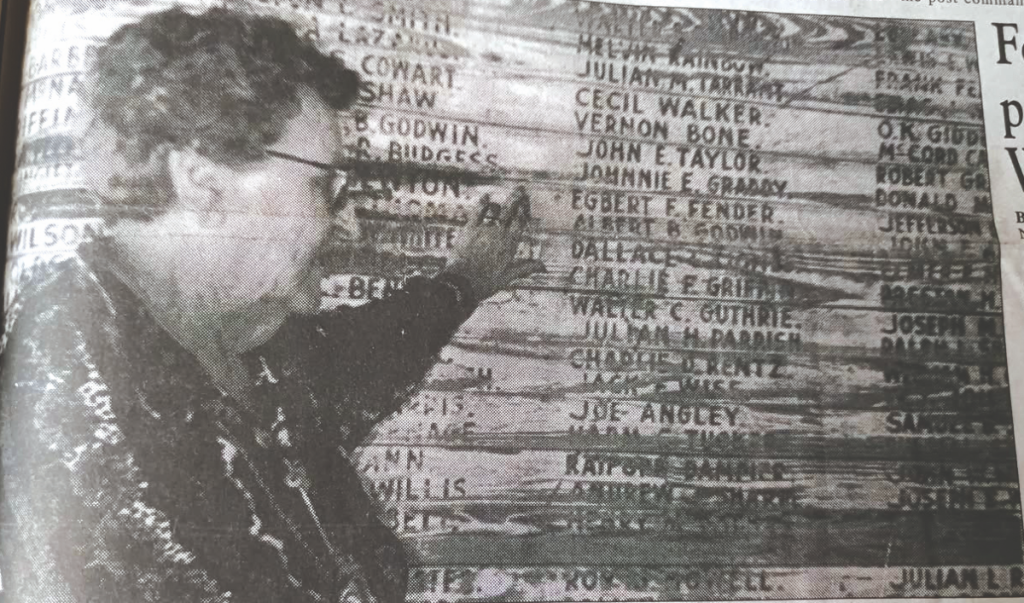
World War II wall display
In the Wednesday, Oct. 18, 1995, issue of the Adel News, Mattie Sumner was shown pointing to a name that she knew on a section of wall displaying the names of men from Cook County who served in World War II. Mrs. Sumner and her husband Robert L. Sumner Sr. owned the old Guy Hendry Farm, where the wall stood for decades.
T
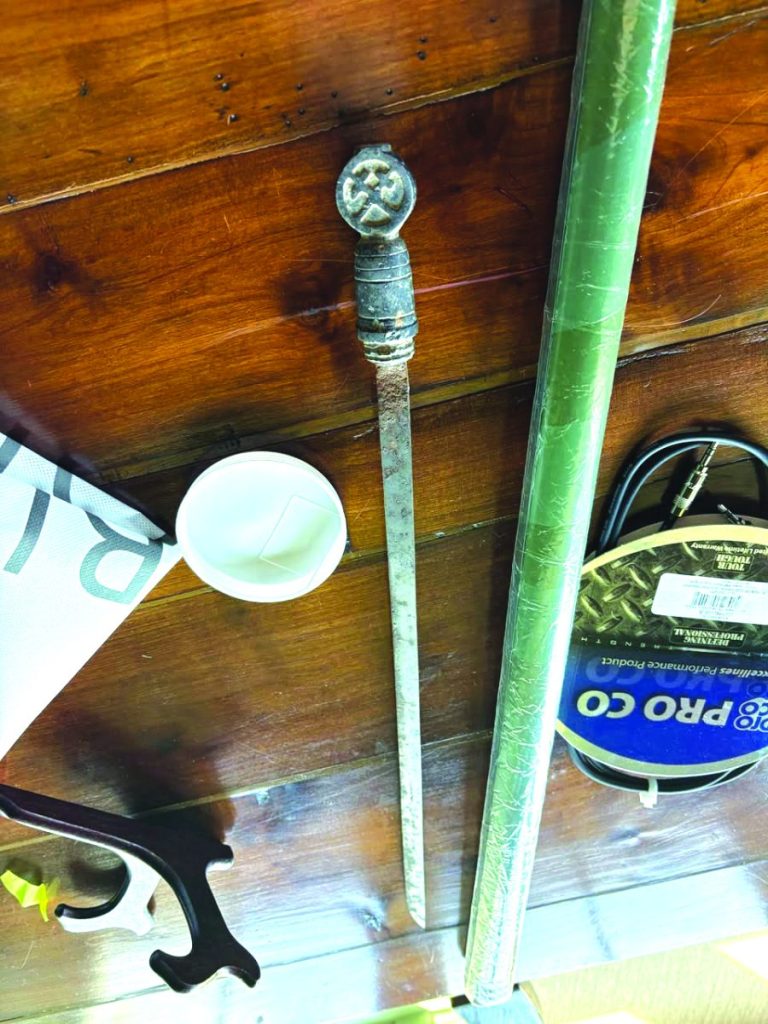
A view of the blade with an unknown origin that was unearthed last week in a field near Alapaha, Ga.
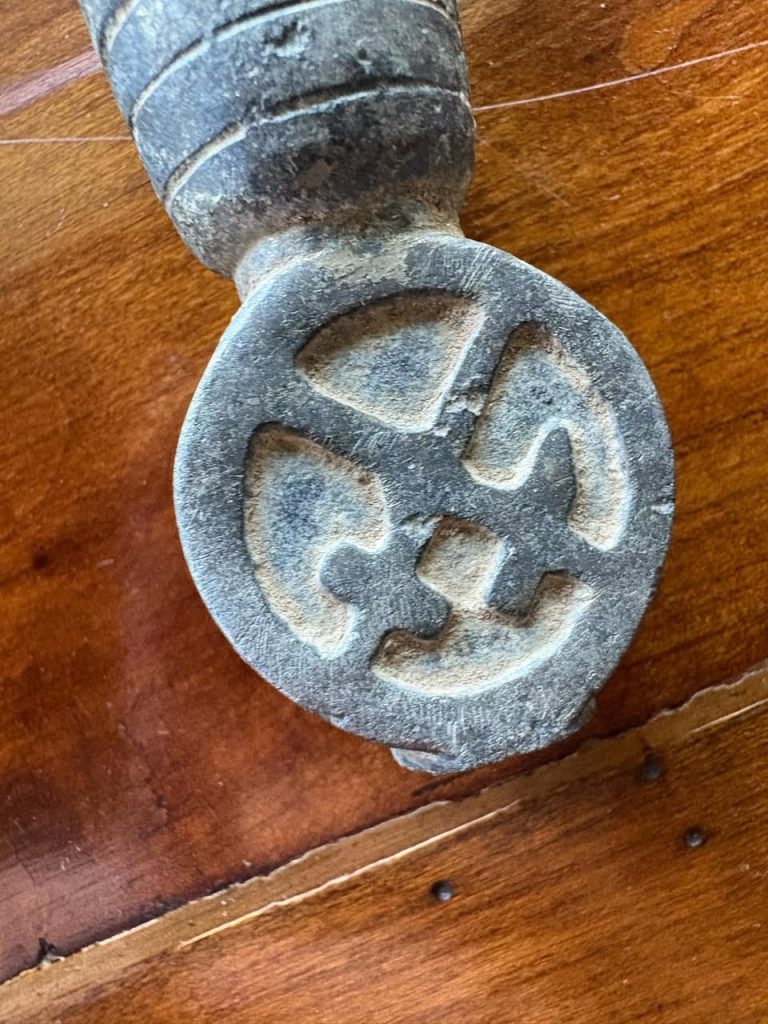
A closer image of the design on the blade.
The backyard ‘Indiana Jones’
By Charles Shiver
I am facing two mysteries about historic artifacts recovered in South Georgia.
What happened to a wall painted with the names of World War II soldiers from Cook County?
And, what IS a strange blade discovered last week in Berrien County?
Thirty years ago this fall, in the Oct. 18, 1995, issue of the Adel News Tribune, I wrote the article headlined, “Forgotten wall painted with World War II soldiers’ names.”
The article reads (I have revised it some):
“If we were prone to exaggeration, we would say the effort required for this story was in the spirit of ‘Raiders of the Lost Ark,’ with the danger of venomous snakes and the search for a mysterious historic relic.
“In this case, the goal of the quest was a wall consisting of boards painted with the names of every Cook County man (apparently) who served his country in World War II.
“Actually, there was nothing epic about finding the wall, or at least a section of it. Telephone calls and a car trip guided by Mattie Sumner of Colquitt County (actually, an Omega address) led a reporter to the old Guy Hendry Farm near Barneyville, where the wall has been part of an old hay barn since the 1950s. Mrs. Sumner and her husband Robert L. Sumner Sr. have owned the property where the barn stands for around 25 to 30 years.
“While looking at a remaining section of the wall, which has been used as a wall for the barn and may be reached under the barn shelter, your intrepid reporter had to step carefully in the shadows around pieces of tin roof and rusty farm equipment. Mrs. Sumner said diamondback rattlesnakes have really been crawling in the area.
“The wall has nine columns of soldiers’ names, with 46 names in each column. However, at least three boards have been knocked out and are missing. The names were written with white paint three to a board on small boards making up the wall. (The list doesn’t include any other information about the soldiers other than their names.) The wall has deteriorated over the years, resulting in the paint peeling here and there and making some of the names illegible. Mrs. Sumner said another section of the wall, just as large as the one now at the barn, was located at the other side of the building, but that section is missing.
“Mrs. Sumner said she recognized many of the names as being those of men who attended school with her in childhood or who have gone to her church. ‘I went to school with Charlie D. Shivers, and I went to church with John E. Taylor,’ she said, pointing to the boards. ‘Walter L. Hinson – One of his sisters married one of my nephews, and another of his sisters married one of my brothers.’ She also recognized the name of Ovendar L. Webb, a minister. Mrs. Sumner attends Lakeview Baptist Church in Lenox. She said some of the men listed have been members of that church and some are now deceased. Two elderly brothers with their names on the wall died just last year.
“As for the wall’s origins, Alex Hendry, son of Guy Hendry, said it was originally set up facing Highway 41 at the northwest corner of the lot around the Cook County Courthouse in Adel.
“The wall was erected around 1944 or 1945, and it displayed the names of all Cook County soldiers who went to war and some who didn’t return, Alex Hendry said. The wall reached from the courthouse almost to the sidewalk. If the count of servicemen’s names is accurate, the wall shows the tremendous impact of World War II on Adel alone since the population at the time was less than 3,000, he said. ‘That’s digging in there pretty good.’
“The wall was taken down in the mid-1950s, in at least two sections and possibly as many as three, Alex Hendry said. The late Guy Hendry, Clerk of Superior Court here for 22 years, bought the wall from the County at an unknown cost and hauled it out to his farm. If he hadn’t, the County would have ‘scrapped’ the wall, the younger Hendry said.
“Guy Hendry, who had served during World War I in France, helped the World War II veterans by recording their discharge for free in the clerk’s office.
“No one has mentioned the wall to Alex Hendry for decades, and he said he doesn’t know whether many veterans have been visiting the farm site. Some veterans whose names are on the wall were contacted by the Adel News Tribune, but they didn’t know that the wall even exists. If you have any more information about the wall, such as who built it and painted the names on it, please contact the Adel News at (229) 896-2233.”
What happened to the wall, or a section that I saw of the larger wall, since I wrote that article approaching three decades ago is an enigma. I have heard that the Colquitt County Historical Society took possession of the wall and moved it to their museum, but I don’t know if that’s true. What happened to the wall might be lost in the fog of time, because the owners of the property where it was located are now deceased. Mrs. Sumner passed away at the age of 79 on Aug. 27, 2001, and Mr. Sumner passed away at the age of 88 on Sept. 14, 2008.
Turning to another archaeological mystery for this area, this strange metal blade shown in the photos was found in the middle of a large field, dug up from farm work, on Wednesday, April 16, 2025, near Alapaha in Berrien County, Ga. It is not very rusty, so it may be from recent times. Any ideas about the origin, or its use?
(Thanks to my niece Stacey for the photos.)
I posted the photos on Facebook, and explanations ranged from a fraternal ceremonial sword for the Knights of Pythias or some other group, dating back to the late 19th or early 20th century; to a Miner’s Guild Concealed Sword Walking Stick; to a stake used to hold the end of a chain for measuring land (surveying).
If it’s a sword cane, the cane part is missing. What makes it even stranger is this question: What is a ritual sword cane doing out in the middle of a field?
Frank Carter post-joked: “That must be placed in the ground immediately. It was used to summon demons.” I replied, “It looks like one of the sacred blades that you could use to off the Antichrist kid in ‘The Omen.’ ”
Seriously, though, I hope the property owner has an expert look at the blade, and probes the ground where it was found to see if there are any missing parts.
It could be an important find in the Alapaha area, known for much inexplicable and tragic news: The site of a famous Atlantic Coast Line train wreck on March 26, 1911, when the Dixie Flyer derailed there, killing 10 and injuring many; the discovery of Native American burial mounds; encounters with the world-famous “Hogzilla,” cougars or panthers (called “tigers” back in the old days, with a lake near Alapaha named “Tiger Bay”), and even a “maned lion”; and much more.
By the way, did you know the word “Alapaha” means in the Creek Indian language “The Other Side”? (“Arapaha,” a variation of the word, means “Bear” or “Bear Lodge.”)